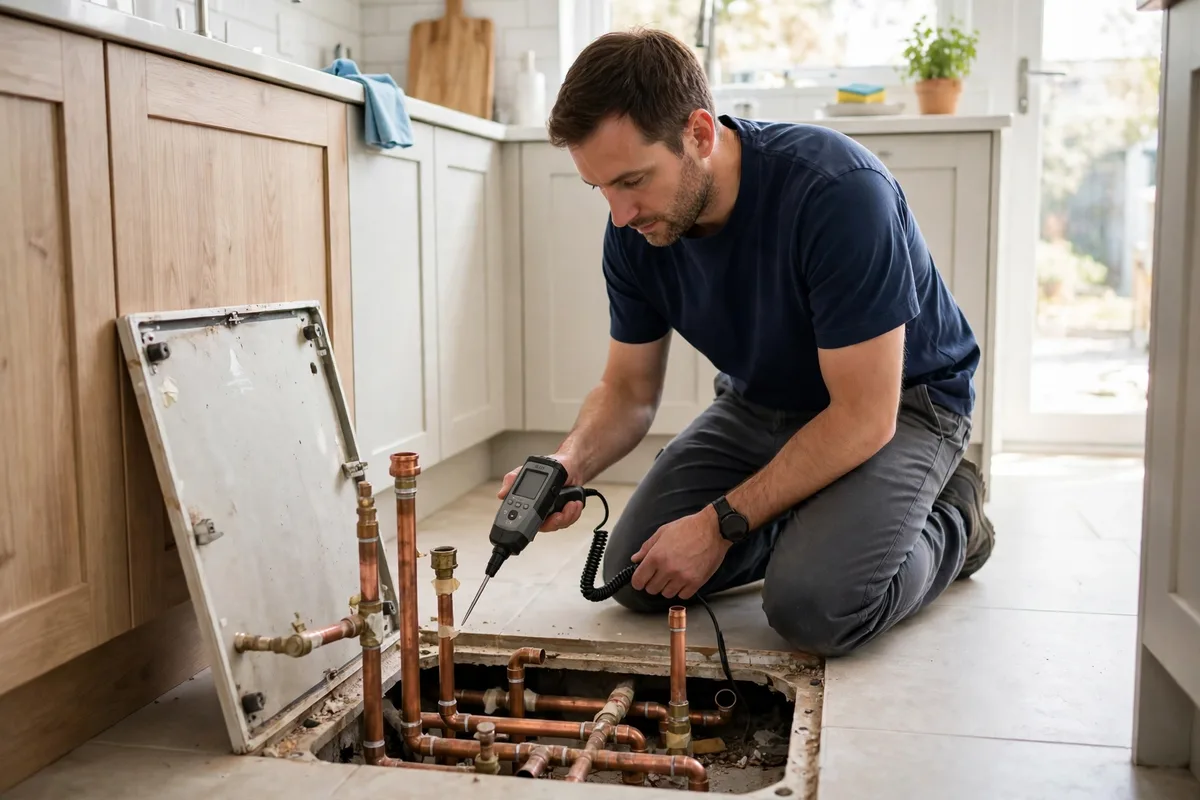
You find a hidden water leak under your slab by confirming the meter still spins with every fixture off, then narrowing the location with sound, thermal, or pressure tools before anyone breaks concrete. The first two things to check are your water meter and the warm spots on your floor - those two signals alone point to a slab leak more often than anything else. This guide walks through the exact steps we use in Sparks, what the warning signs look like in our soil and climate, what a detection visit costs in 2026, and when it is time to stop guessing and call someone.
What a slab leak actually is
A slab leak is a pressurized water line failure beneath your home's concrete foundation that lets water escape into the soil under the slab. It is not the same as a drain leak or a sewer leak - those carry wastewater and behave differently. A slab leak is on the supply side, which means it runs 24 hours a day until you shut the main off.
In Sparks, most homes built between the 1970s and early 2000s have copper supply lines running under the slab. Copper reacts to our soil chemistry - alkaline, mineral-heavy, and in some pockets high in sulfates. That combination pits the pipe wall from the inside out. By the time you see water, the pipe has usually been thinning for years.
Newer builds in Wingfield Springs Leak Detection and similar master-planned communities often use PEX or CPVC. Those materials fail less often, but when they do, the failure is usually at a fitting or a kink rather than along the pipe run. The detection method is the same; the repair is different.
How do I find a water leak under my slab in Sparks?
You find a water leak under your slab in Sparks by running a meter test first, then using sound and temperature to narrow the location. Here is the sequence, in order.
- Shut everything off. Close every faucet, turn off the ice maker, the irrigation, the pool auto-fill, and the water heater. Wait 15 minutes.
- Read the meter. If the low-flow dial (the small triangle or star) is still turning, you have a leak on the supply side. If it is still, the leak is on the drain side or intermittent.
- Listen at the floor. Put your ear to the slab in the quietest room. A hiss or a steady trickle that does not change when you turn a faucet on is a strong slab-leak signal.
- Check floor temperature. A hot-water slab leak warms the concrete above it. Bare feet find these faster than any tool.
- Isolate zones. If you have a manifold or shutoff valves for different parts of the house, close them one at a time and re-check the meter. When the dial stops, you have found the zone.
That gets you a yes-or-no answer and a rough zone. It does not get you an X on the floor. Pinpointing the exact spot under 4 inches of concrete takes acoustic listening equipment, thermal imaging, and often a pressure test on the isolated line. That is the part where most homeowners stop and call us.
What are the signs of a slab leak in Sparks NV?
The signs of a slab leak in Sparks NV are a spiking water bill, warm or damp floor spots, the sound of running water with everything off, and cracks that appear suddenly in tile or drywall. Any one of these is worth a meter test. Two or more together almost always means a slab leak.
Here is what we actually see on calls across the city:
- Water bill jump. A slab leak typically adds 2,000 to 8,000 gallons a month. If your bill doubled and nothing changed in the household, start here.
- Warm spots on the floor. Hot-water lines under the slab heat the concrete. A 3 to 6 foot warm patch in a hallway or kitchen is a classic sign.
- Damp carpet or buckling flooring. Water wicks up through the slab and finds the lowest point. Carpet padding stays wet long after the surface feels dry.
- Sound of running water. With every fixture off, you should hear nothing. A steady hiss near a wall base is a leak.
- Hairline cracks in tile or drywall. Soil under the slab expands when saturated. That movement cracks grout lines and drywall corners.
- Mold or musty smell. In our dry climate, indoor mold almost always traces back to a moisture source - and a slab leak is a common one.
One more thing specific to Sparks: if your home sits on expansive clay soil, a slab leak can also cause doors to stick and gaps to open at the baseboards. The soil swells on the wet side and shrinks on the dry side, and the foundation moves with it.
Can I detect a slab leak myself in Sparks?
You can confirm that a slab leak exists yourself in about 20 minutes with a meter test and a walk around the floor. You cannot reliably pinpoint the exact location without professional equipment - and guessing wrong means breaking concrete in the wrong place.
What you can do on your own:
- Run the meter test described above.
- Walk the floor barefoot or with a laser thermometer and map any temperature differences.
- Check the water heater pan, the irrigation shutoff, and the pool auto-fill before assuming it is the slab. Those three account for a surprising share of "slab leak" calls that turn out to be something else.
- Photograph your meter reading before and after a two-hour window with no water use. That gives a technician a real number to work from.
What you should not do: chip into the slab to "see" where the water is. You will spend money on concrete repair and still not know where the leak is. The tools that find slab leaks - acoustic microphones, thermal cameras, and line pressure testers - cost more than the detection visit itself.
If your meter test points to a supply-side leak, the next call is to a pro. We handle slab leak detection Sparks NV with acoustic and thermal gear and mark the spot on the floor before anyone touches a saw.
How much does slab leak detection cost in Sparks Nevada?
Published market ranges for leak detection run $120–$400 (HomeYou) and $190–$720 for electronic and acoustic detection (Plumbing Advisors). Slab leak location runs $310–$1,070 (Plumbing Advisors). That covers the meter test, acoustic listening, thermal scan, and a marked location on the floor.
What moves the price:
- Home size and slab layout. A 1,200 sq ft ranch is faster to scan than a 3,500 sq ft two-story with a post-tension slab.
- Number of suspect lines. One hot line is quick. Multiple zones or a combined hot/cold manifold takes longer.
- Access. If the manifold is buried behind drywall or under a cabinet, we spend time getting to it before we can isolate.
- Post-tension slab. These require extra care because cutting a tendon is a structural problem. Detection is the same; the repair plan changes.
Repair is separate. A spot repair on a copper line is quoted per job depending on how much concrete has to come up and how the line is rerouted. Whole-home repiping is a different conversation - we cover it under repiping Sparks NV when the pipe has failed in more than one place.
One note on insurance: most homeowner policies cover the water damage from a sudden slab leak but not the pipe repair itself. Document everything with photos and keep the detection report - that is the document your adjuster will ask for.
Common mistakes homeowners make
The most expensive mistake is waiting. A slab leak that runs for a month can undermine the soil under your foundation, and foundation repair costs far more than the pipe fix.
Other mistakes we see regularly:
- Assuming it is the water heater. A leaking water heater pan looks a lot like a slab leak from the inside. Check the pan first - it is a five-minute test.
- Turning the main off and forgetting it. Shutting the main stops the water, but the soil under the slab is already saturated. It needs to dry, and the pipe still needs repair.
- Hiring the cheapest bid without a detection report. If a contractor quotes a repair without locating the leak first, they are guessing. You will pay for concrete either way.
- Ignoring a small bill increase. A pinhole leak at 1 gallon per hour is 720 gallons a month. That is real money and real soil movement.
- Cutting into a post-tension slab without an engineer. This can compromise the foundation. Always confirm slab type before any cutting.
We also get calls from homeowners in Kiley Ranch Leak Detection who assume newer construction rules out a slab leak. It does not. Fitting failures happen in new builds too, and they show up in the first few years.
When to call a professional
Call a professional the moment your meter test confirms water is moving with everything off. That is the line between "watch it" and "fix it."
A few situations where you should not wait at all:
- Water is visibly pooling at a wall base or seeping through a floor seam.
- Your water bill jumped in one cycle.
- You smell musty air in a room with no other moisture source.
- Doors or windows have started sticking in the last 60 days.
- You have already had one slab leak repaired and the meter is spinning again.
Our team at Sparks Leak Pro runs detection first, marks the spot, and gives you a written repair plan with a fixed price before we cut anything. If the leak turns out to be on the drain side instead, we handle that too - sewer leak detection Sparks NV uses different tools and a different repair approach, and we will tell you which one you are dealing with before you spend a dollar on concrete.
For a broader look at what we do across the city, our Leak Detection Sparks NV page covers every service line we run.
Frequently Asked Questions
How do I find a water leak under my slab in Sparks?
Shut off every fixture, wait 15 minutes, and check the low-flow dial on your water meter. If it is still turning, you have a supply-side leak. Then listen at the floor and check for warm spots. That confirms a slab leak in about 20 minutes; pinpointing it takes acoustic and thermal equipment.
What are signs of a slab leak in Sparks NV?
The top signs are a water bill jump of 2,000 to 8,000 gallons, warm spots on the floor, the sound of running water with everything off, damp carpet, and new cracks in tile or drywall. Two or more together almost always means a slab leak.
Can I detect a slab leak myself in Sparks?
You can confirm one exists with a meter test and a barefoot walk across the floor. You cannot reliably pinpoint the location without acoustic and thermal tools. Guessing wrong means breaking concrete in the wrong spot, which costs more than the detection visit.
How much does slab leak detection cost in Sparks Nevada?
Published market ranges for leak detection run $120–$400 (HomeYou) and $190–$720 for electronic and acoustic detection (Plumbing Advisors). Slab leak location runs $310–$1,070 (Plumbing Advisors). That includes the meter test, acoustic listening, thermal scan, and a marked location. Repair is separate and quoted per job.
Does homeowners insurance cover a slab leak in Sparks?
Most policies cover the water damage from a sudden slab leak but not the pipe repair itself. Keep your detection report and photos of the damage - your adjuster will ask for both. Read your policy's foundation and pipe exclusions before you file.
Get help with Leak Detection in Sparks
If your meter is spinning and your floor is warm, you have a slab leak and it is not going to fix itself. We find it, mark it, and repair it - with a fixed price before we cut concrete.
Call Sparks Leak Pro at (775) 505-6540 to schedule detection this week.